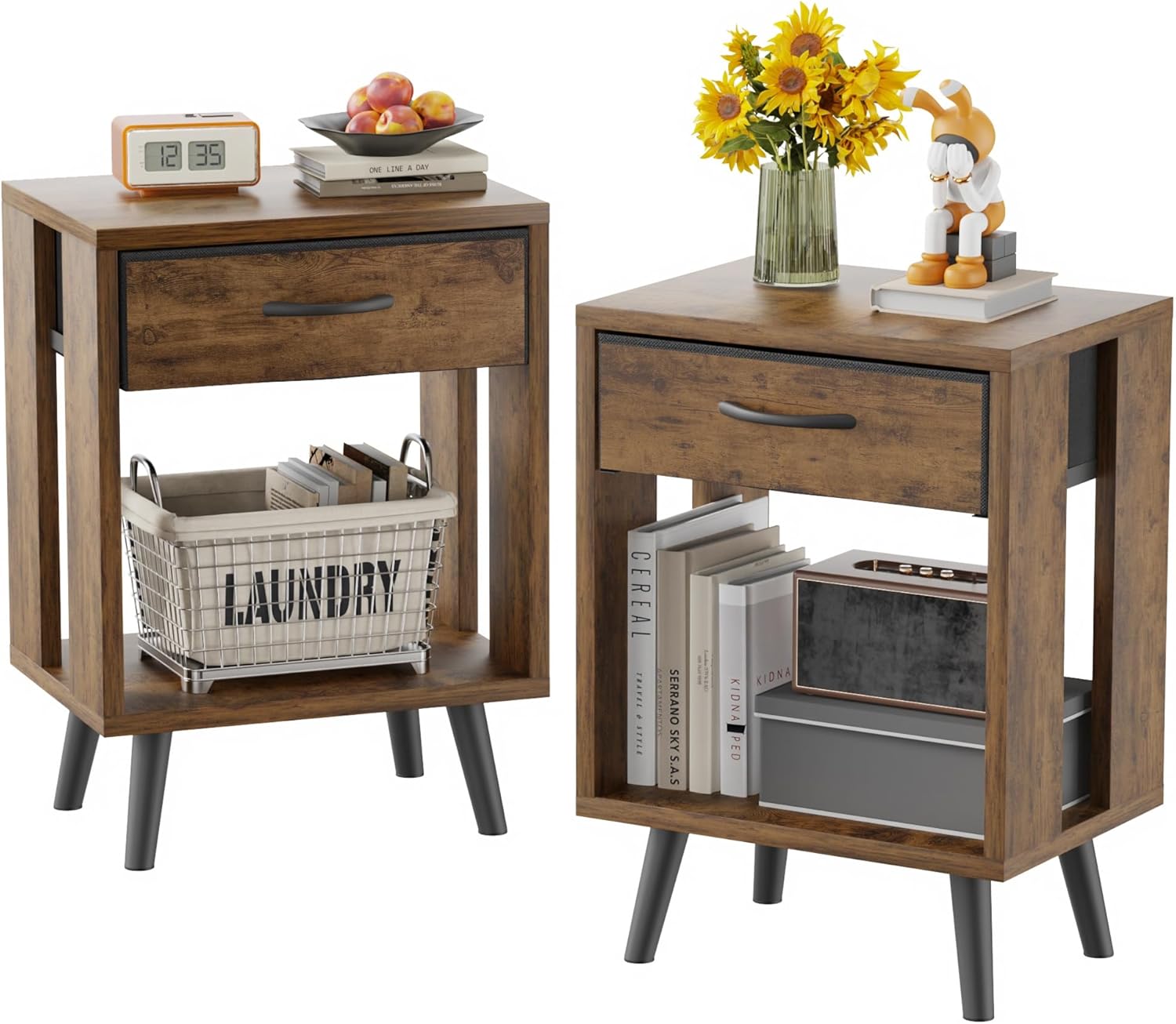
A Matching Pair Commits You to One Footprint on Both Sides
A set of two nightstands is convenient, but it removes a choice you would otherwise have: you cannot put a slim table on one side of the bed and a wider cabinet on the other. Both sides receive the same unit, so the tighter side sets the limit for the whole purchase. That matters in bedrooms where one side sits against a wall and the other sits beside a wardrobe, a window or an inward-swinging door. Before you compare designs, walk around the bed and note what is genuinely available on each side. If one side has clearly less width or depth, a matching pair may be the wrong format for the room, and two different pieces may serve you better.
Measure Both Sides of the Bed Before You Compare Sets
Measure from the edge of the bed to the nearest obstruction on each side, at the height where the nightstand will sit. Record the narrower figure, because that is what constrains a set. Then compare it with the stated footprint. This listing gives 15.7 inches by 11.8 inches by 23.6 inches high, but it does not say which figure is the front-to-back depth, so confirm the orientation on the product page or with the seller rather than assuming it fits your gap.
Height deserves its own check. The top of the nightstand is where a lamp, a glass or a phone will sit, so it should be comfortable to reach from lying down. Comparing it with your mattress top is a reasonable starting point, though the right height depends on your bed and your reach. Finally, find the wall outlets on both sides, because a pair usually means two lamps and two cables.
Decide Whether Both Sides Need the Same Kind of Storage
This set combines fabric drawers with open shelves. That mix suits two common bedside habits: closed storage for items you want out of sight, and an open shelf for a book, a lamp base or a glass of water. It suits a pair less well when one sleeper wants a deep closed drawer and the other needs only a flat surface. Before ordering, list what actually lives beside each of you for a week, not the idealised version, then check that the two storage types cover those items.
The listing does not state a weight limit for the drawers or shelves, so treat load guidance as unknown and ask the seller before placing anything heavy in them. Fabric drawers also raise practical questions about how they are supported and how they should be cleaned, and the listing does not answer those either.
What the Nightstand Set of 2 Listing Confirms and What It Leaves Open
Confirmed by the listing: the product is sold as a set of two, it has fabric drawers and open shelves, the colour is described as dark rustic brown, and the stated size is 15.7 by 11.8 by 23.6 inches. Not confirmed: the frame material, the fabric content of the drawers, load limits, assembly requirements, care instructions and whether the two units match in every respect. A finish name such as dark rustic brown describes a colour, not a construction material, so it is not evidence of solid wood.
The catalogue also describes the design as unique and refers to a pending patent application. That is a seller statement rather than independent verification, and it says nothing about how the piece behaves in daily use. Before ordering, ask the seller for the frame material, the drawer dimensions and how far the drawers travel, weight guidance, assembly instructions and a care recommendation.
A Pairing Checklist You Can Run in Ten Minutes
Measure each side of the bed separately and plan around the smaller figure. Confirm which stated dimension is depth and which is width. Compare the height with your mattress and how far you have to reach. Note outlets, lamp cables, and any wardrobe or bedroom door that swings into either space. Write down what each sleeper stores at night, then decide whether two identical units genuinely suit both people. Ask the seller about material, drawer load limits, assembly and care before you commit.
If one side fails any of these checks, the honest options are to rearrange the furniture around the bed, accept a smaller footprint than the set offers, or buy two separate pieces instead of a matched pair.
When the Pair Is the Right Answer
A matching set is the straightforward choice when both sides of the bed have similar clearance, both sleepers want the same combination of hidden and open storage, and the stated height and footprint work with your mattress and your reach. In that case, the set saves you the work of matching two different pieces and keeps the bedside symmetrical, which is often what makes a small bedroom feel calmer. If any of those conditions fails, the pair is likely to be a compromise on one side of the bed every night.
Explore related furniture
Related questions
Do both nightstands in a set have to be the same size?
A set of two normally provides two identical units, so the roomier side of the bed does not get extra space and the tighter side does not get less. That is why you measure both sides and plan around the smaller figure. If one side is noticeably narrower or shallower, two separate pieces may fit the room better than a matched pair.
Is the dark rustic brown finish solid wood?
The listing names a colour, not a material, so it does not confirm solid wood or any other construction. Ask the seller for the frame material and the finish type, then request care instructions that match that answer. The stated size of 15.7 by 11.8 by 23.6 inches is the main dimensional information the listing provides.
How much clearance do fabric drawers need to open?
The listing does not state how far the drawers travel, so measure the floor space in front of each nightstand and confirm drawer depth and pull-out distance with the seller. As general planning advice, allow the drawer to open without hitting the bed frame, a wall or a door, and check that you can still walk past while it is open.