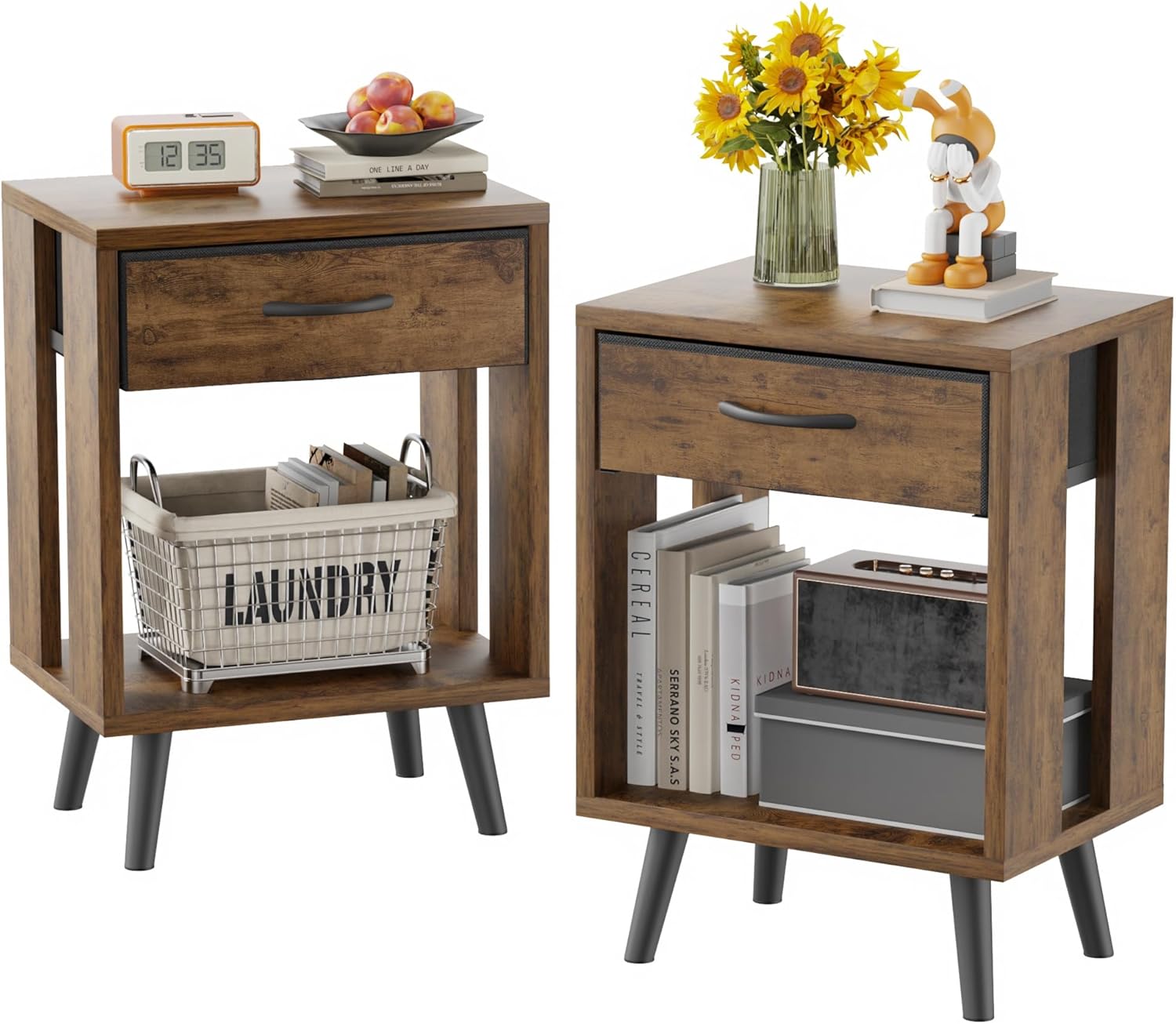
Sort Bedside Items by When You Touch Them, Not by Size
The split between shelf and drawer follows touch time, not the size or quantity of your things. Put the items you reach for without sitting up on the open surface, and the items you handle at the start or end of the night in the drawer. The condition is that both must be usable from your usual sleeping position; a drawer that needs you to stand up has already lost its advantage over a shelf.
A quick way to test this is to list what is currently on your bedside surface and mark each item: touched while lying down, handled sitting on the bed, or kept nearby for rare use. If most items fall in the first group, an open shelf carries the routine and a drawer mostly holds overflow. If most fall in the second and third groups, a drawer reduces visible clutter and the shelf becomes a place for one or two active items.
Open Shelves Suit Repeated, Unhidden Access
An open shelf suits anything you pick up and put down repeatedly during the night, because there is no drawer to pull, no front to close and nothing to remember. The condition is that the shelf must be at a height and depth where items stay where you put them; a narrow or high shelf turns a simple reach into a stretch.
The trade-offs are dust and visibility. A shelf exposes everything to room dust, and anything loose, such as earbuds, a pen or a small remote, can be knocked off in the dark. A shallow tray or a small container on the shelf can hold those pieces together without turning the shelf into a drawer.
Fabric Drawers Suit Items You Want Contained and Out of Sight
A fabric drawer suits items you handle before sleep or do not want on display, because it contains loose pieces and removes them from the room's visible surface. The condition is access: you need a free hand and enough room beside the bed to pull the drawer open, and the drawer must not be blocked by the mattress, a wall or a nearby door.
The listing names fabric drawers but does not describe their interior size, how far they pull out or whether they have a stop. Soft-sided drawers also hide their contents, so an unchosen layout is easy to forget. Keep the drawer for a small, stable set of items and leave the shelf for the things you use often.
A Split Arrangement Works When Both Parts Are Reachable
The split arrangement, an open shelf for nightly items and a drawer for the rest, suits a routine that mixes both kinds of use. It works only when the shelf and the drawer handle both fall within reach of where you lie or sit, and when opening the drawer does not require moving the lamp, a glass or anything else on the top.
Before committing, check the order you do things in. If you take glasses off and put them away last, the drawer needs to be easy to close from a lying or half-sitting position. If you pick up a book first and set it down repeatedly, the shelf should be the closer of the two.
Judge Height Against Your Mattress, Not the Floor
The height that matters is where the shelf and drawer sit relative to your mattress top, not the overall height of the table. The listing gives the night stand as 15.7 in long, 11.8 in wide and 23.6 in high, which describes the whole unit; it does not state the shelf height, the drawer front height or where the storage sits within that 23.6 in.
Measure your mattress top and then compare it with the storage positions once the seller supplies them. A shelf well below the mattress edge is harder to use without leaning down, and a drawer that opens at mattress level can conflict with bedding overhang.
What to Confirm About This Set Before Choosing Drawers or Shelf
Treat the drawer and shelf decision as unconfirmed for this set until the seller supplies the missing figures. The listing names the model, the dark rustic brown finish and the fabric drawers with open shelves, and gives the overall size of 15.7 in by 11.8 in by 23.6 in, but no drawer interior, shelf depth or compartment positions.
Useful questions are the interior width and depth of each drawer, how far a drawer extends when opened, whether it has a stop, the height and depth of the open shelf, and the care instructions for the drawer fronts. If you need the drawer to hold something specific, compare its interior against that item rather than against the table's overall length.
Explore related furniture
Who this helps
A reader is setting up one or both sides of a bed with a nightstand set of two that has fabric drawers and open shelves, and wants to decide which items belong in the drawer and which on the shelf before filling them.
How to make the choice
Choose the open shelf for items touched repeatedly while in bed and the fabric drawer for items handled once at the start or end of the night, or kept out of sight. The trade-off is that the shelf keeps things reachable but visible and exposed to dust, while the drawer contains clutter but demands a free hand, clear space and enough pull-out travel, which this listing does not state.
Information behind this guide
Product facts here come only from the listing: a nightstand set of two with fabric drawers and open shelves in dark rustic brown, with an overall size of 15.7 in long, 11.8 in wide and 23.6 in high. Drawer interior sizes, pull-out travel, shelf height and depth, materials and care instructions are not given, so they remain unconfirmed. The sorting and reach advice is general editorial guidance, not a product test.
Compare your options
| Option | Consider when | Limitation | What to verify |
|---|---|---|---|
| Open shelf | Items you touch repeatedly while in bed, such as a book, remote or phone you put down and pick up again, because nothing has to be opened or closed to reach them. | Everything stays visible and collects dust, and loose small items can be knocked off because an open shelf provides no containment. | Confirm the shelf height relative to your mattress top and the shelf depth, since the listing gives only overall dimensions. |
| Fabric drawer | Items you handle before sleep or prefer out of sight, such as reading glasses, a charger or spare bedding, because the drawer hides them and contains small pieces. | You need a free hand and clear space to open it, and a soft-sided drawer hides its contents, so you have to remember where things went. | Ask the seller for the drawer interior size and how far it pulls out; the listing names fabric drawers but gives no interior figures. |
| Shelf for nightly items, drawer for the rest | Mixed routines where some things are touched in bed and others are only used at the start or end of the night. | It only works if the shelf and the drawer are both reachable from where you sit or lie, and if opening the drawer does not force you to move the lamp or other items. | Check your reach from the pillow to the shelf and to the drawer handle in your own room before buying. |
Your decision checklist
- Sort every bedside item into three groups: touched while lying in bed, handled sitting on the bed, and kept nearby for rare use. The first group points to an open shelf; the second and third point to a drawer.
- Sit or lie where you normally sleep and check the reach to the shelf position and to a drawer handle. A storage point that needs you to sit up or lean over has already changed the routine.
- Compare your mattress top with the night stand's overall 23.6 in height to see roughly where the storage sits, then ask the seller for the shelf height and drawer front height before planning.
- Ask for each drawer's interior width and depth and its full pull-out distance, because a fabric drawer name does not state capacity and this listing gives no interior figures.
- Decide what will hold loose small items on the open shelf, such as a shallow tray, so they are not knocked off during the night.
- Request care and assembly instructions for the drawer fronts and shelf before buying, since the listing does not state the material or a cleaning method.
Related questions
Can a drawer replace an open shelf for nightly items?
Only for items you are willing to open a drawer for. If you read, use a remote or set down glasses repeatedly while in bed, an open shelf keeps that to one movement; a drawer adds opening and closing each time. A drawer becomes the better choice when the item is handled once at the start or end of the night, or when it needs to stay contained and out of sight.
What drawer and shelf figures does this listing not give?
The listing gives overall dimensions of 15.7 in long, 11.8 in wide and 23.6 in high and names fabric drawers with open shelves, but it does not state drawer interior sizes, drawer pull-out distance, shelf height or shelf depth. Ask the seller for those figures, plus assembly and care instructions for the drawer fronts, before you plan what goes where.
Does a drawer keep bedside items dust-free compared with a shelf?
A closed drawer reduces dust settling on the items inside compared with an open shelf, but the drawer interior and its runners still collect dust and need occasional cleaning. Check the seller's care instructions before using cleaners or polish on the drawer fronts, because the listing does not state the front material or a cleaning method for this model.