Sort bedside items into four reach bands before placing anything
Sorting bedside items by how you reach them, rather than by what they are, is what keeps a small nightstand top from filling up. Walk through an ordinary evening and morning and name every object you touch: glasses, phone, book, water, medication, hand cream, headphones, a charger. Then place each one in a band based on where your hand is when you use it — lying in bed, sitting on the bed edge, standing beside it, or rarely at all.
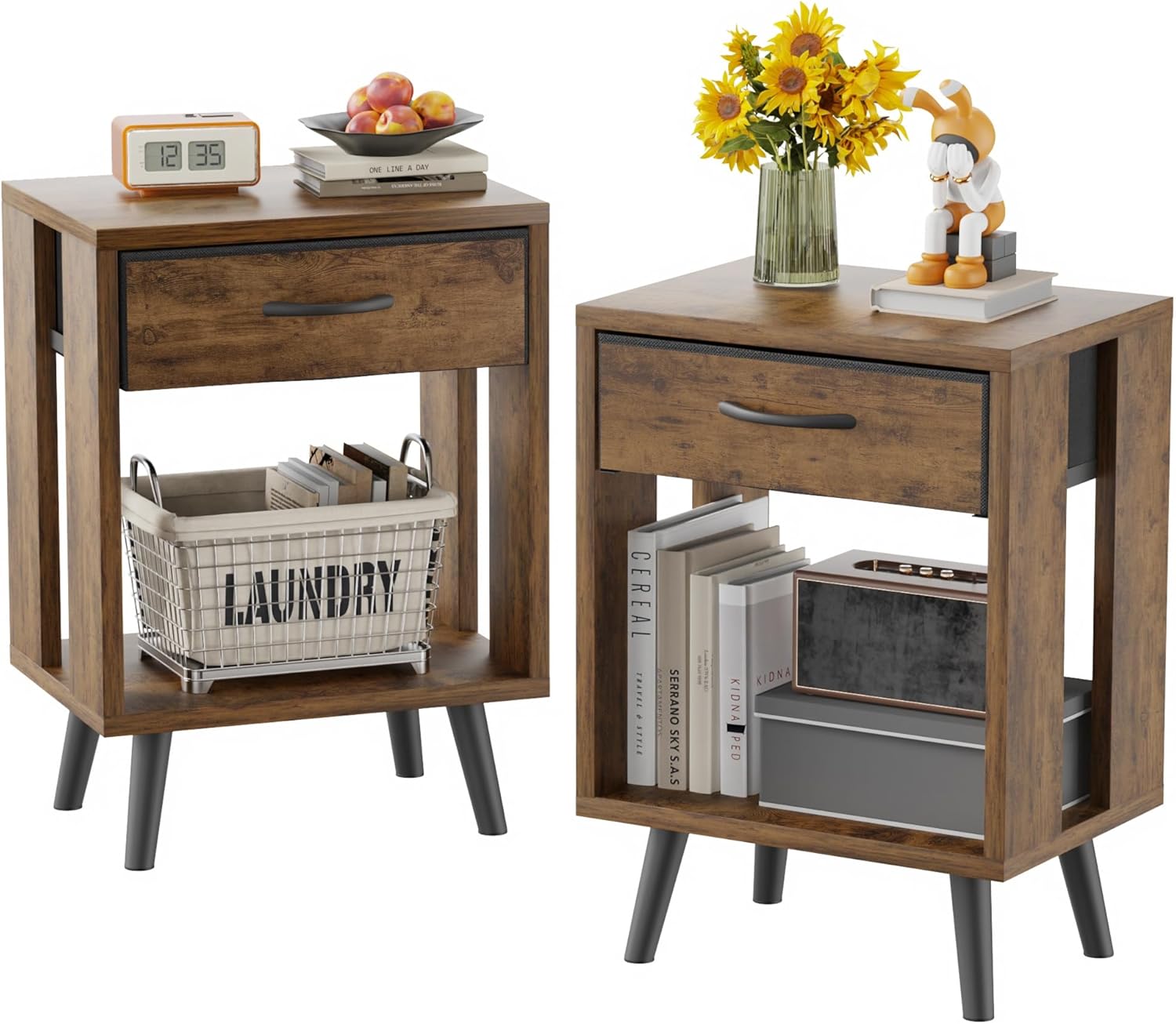
The bands are the real decision, because a nightstand has only three usable zones: the top, the open shelf and the drawers. The top suits items used from a lying position; the shelf suits items used while sitting or passing; the drawer suits items you want out of sight and do not need mid-sleep. Anything that appears in none of those moments leaves the nightstand entirely. Judge this with a week of real use, because one tidy evening will not show you which objects keep arriving.
Set a top-surface budget and measure the lamp base first
The top should hold only the items you touch while lying in bed, so measure that group before you add a lamp. Lamps usually occupy the largest footprint on a bedside top, and their base can overhang a narrow surface or sit close to the edge. Put the lamp base, charger and glass together on a sheet of paper, trace the combined outline, then compare it with the top surface you have confirmed.
The listing for this set of two gives overall dimensions of 15.7 in long, 11.8 in wide and 23.6 in high, but it does not separate the top surface from the overall footprint. If the top has a raised edge, a lip or a different depth to the body, the usable flat area is smaller than the overall figure. Ask the seller for the top surface dimensions before buying a large-based lamp or a wide charging dock.
Give the open shelf the daily items that do not need to be in bed
The open shelf is the band for items you use most days but not from a lying position — a reading book, tissues, headphones, a remote, a second pair of glasses. Open storage keeps those items visible and reachable without consuming the top surface.
Because the shelf is open, it also shows clutter, so it works better as a fixed set of slots than as spare capacity. Assign each shelf item a position and stop when the shelf is full; overflow goes to a drawer or leaves the unit. The listing does not give the shelf opening height, depth or the gap below the top, so confirm those measurements with the seller before buying baskets intended to slide in.
Match soft fabric drawers to light, low-risk items
Fabric drawers suit light, low-risk items that you want out of sight, such as spare chargers, sleep masks, notebooks or folded clothing. Because the drawer sides are soft rather than rigid, confirm the drawer's interior dimensions and any load guidance with the seller before filling it, since the listing does not state them.
Keep liquids, anything that must stay upright, sharp or heavy objects, and anything that needs to be secured out of these drawers; those items need a rigid closed surface or a different storage location. Also check how the drawer runs, because a fully open drawer needs clear floor space in front of the nightstand. Leave that travel distance free on both sides of the bed before you rely on the drawer for nightly items.
Decide what leaves the nightstand permanently
Anything you have not touched at the bedside in a week does not need nightstand storage, and moving it out is what creates room for the items that do. Common candidates are duplicate chargers, spare cables, unused medication kept just in case, old magazines and a second water bottle.
Give each departing item a real destination — a charging drawer elsewhere, a bathroom cabinet, a recycling bin — rather than a pile on the floor beside the bed. Charging is a frequent offender: if the cable reaches a wall outlet, the charger itself can live at the wall and free the whole top edge. Check the cable run first, and keep cables out of walking routes rather than looping them across the floor.
Set up the second nightstand around the other person's routine
A set of two nightstands does not need identical contents, because the person on each side reaches for different things and the space beside each side of the bed can differ. Set up each unit from its own routine list rather than copying the first one across.
Check both sides separately: mattress height, wall or door clearance, the outlet position and how much room the drawer has to open. Where one side has a door, a low window or a narrow gap, the usable zone may be the shelf rather than the drawer. If the two sides end up with different contents, that is a fit decision, not a mismatch.
Use a short weekly reset to stop the top filling again
A nightstand top refills because items arrive without a home, so a weekly reset is part of the system rather than a sign it failed. Pick a fixed moment, take everything off the top, and return each object to its band — in-bed items back on the top, daily items to the shelf, out-of-sight items to the drawer, and everything else out of the room.
Finish by checking the two things that are easy to forget: that the lamp base is still fully on the surface, and that drawer travel and cable runs are still clear. If the same object keeps landing on the top without being used in bed, treat that as evidence it needs a different home rather than another tidy-up.
Explore related furniture
Who this helps
A buyer has ordered or is considering the nightstand set of 2 with fabric drawers and open shelves in dark rustic brown, and finds the top surface filling within a week with a lamp, chargers, glasses and loose objects despite regular tidying.
How to make the choice
Keep an item on the top only if you use it while lying in bed; move items used while sitting or standing to the open shelf, and out-of-sight items to a drawer. The trade-off is convenience, since anything moved off the top takes one extra reach — so if you genuinely use it nightly from bed, the top is its correct home.
Information behind this guide
The listing describes fabric drawers and open shelves and gives overall dimensions of 15.7 in long, 11.8 in wide and 23.6 in high. It does not state drawer interior sizes, shelf clearance, load guidance or care instructions, so those remain unconfirmed and should come from the seller. The reach-band and reset advice here is general organisation guidance, not product testing.
Compare your options
| Option | Consider when | Limitation | What to verify |
|---|---|---|---|
| Top surface | Items you use while lying in bed, such as glasses, a phone, or medication taken at night. | Smallest zone on the unit and the one most easily overfilled, with a lamp base competing for the same area. | Confirm the top surface dimensions separately from the overall 15.7 in by 11.8 in listing figure, including any lip or raised edge. |
| Open shelf | Daily items you use while sitting or passing, such as a book, tissues, headphones or a remote. | Fully visible, so it reads as clutter as soon as it holds more than its assigned items. | Ask the seller for the shelf opening height, depth, and the gap between the shelf and the underside of the top. |
| Fabric drawer | Light, low-risk items you want out of sight and do not need to reach mid-sleep. | Soft sides and unstated interior dimensions make these drawers a poor fit for heavy, sharp or leaky items. | Confirm interior dimensions, load guidance and full drawer extension with the seller before buying inserts. |
| Off the nightstand | Duplicates, spare cables, seasonal items and anything you have not reached for in a week. | Removes convenience, so only items you never use from bed should leave. | Identify a real destination for each departing item instead of a pile on the floor beside the bed. |
Your decision checklist
- Walk through your bedtime and morning routine and write down every item you actually touch; anything unused for a week has not earned nightstand storage.
- Measure the lamp base, charger and glass together as one group, then compare that combined footprint with the top surface dimensions confirmed by the seller.
- Ask the seller for drawer interior dimensions and open shelf clearance, because the listing gives only the overall 15.7 in by 11.8 in by 23.6 in figures.
- Keep liquids, items that must stay upright, sharp or heavy objects and anything needing a lock out of soft-sided fabric drawers.
- Check how far a fully open drawer travels and keep that floor space clear on both sides of the bed before relying on the drawer nightly.
- Set up the second nightstand from the other person's own routine list, after checking that side's mattress height, clearance and outlet position separately.
Related questions
How do I stop the nightstand top from becoming a dumping ground?
Decide that the top holds only items you use from a lying position, then give every arriving object a band before it lands there. A landing tray usually makes this worse unless everything on it is used nightly. If the same object keeps appearing on the top without being used in bed, move it to the shelf, a drawer or out of the room at your weekly reset.
What should stay out of a soft-sided fabric drawer?
Keep liquids, anything that must stay upright, sharp or heavy items, and anything that needs to be locked out of a fabric drawer with soft sides. Confirm the drawer's interior dimensions and any load or care guidance with the seller, because the listing for this set does not state them. Light, low-risk items suit this kind of drawer better.
Should both nightstands in a set be organised the same way?
Only if both users reach for the same things in the same order. Organise each side from its own routine list, then compare: matching appearance does not mean matching storage needs, and one side may have a door, a narrower gap or a different outlet position. It is fine for the two units to hold different contents.