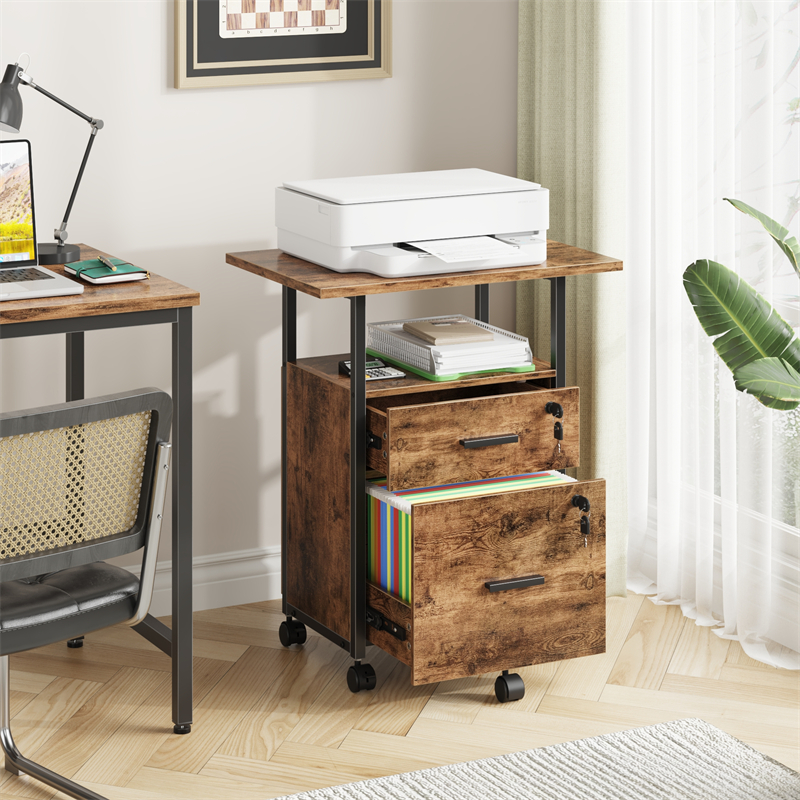
Access frequency decides before anything else
Sort your paperwork into three groups by how often you touch it: papers you open in a working week, papers you consult a few times a year, and papers you keep only because you may need them later. Hanging files reward the first group, because folders sit upright in a row and their tabs are visible when the drawer is open. Document boxes reward the other two, because they hold a batch together and can be closed, stacked and moved without repacking. If one group clearly dominates, the choice is straightforward. If all three exist in volume, plan for both rather than forcing one system to do every job.
What hanging files do well, and where they fall short
Hanging folders suspend from rails or a frame so the top edge of every folder stays in view, which shortens the time spent searching for a specific document. Individual tabs let you label by month, client or category without opening anything. The trade-offs are structural: the drawer must provide the rails, enough interior width, enough clear height for folders and their contents, and enough travel to open fully. Folder tops remain open to dust, and heavy contents can make a folder sag. None of this can be judged from a product name alone, so ask the seller whether rails or an insert frame are supplied and what folder depth the interior accommodates.
What document boxes do well, and what you give up
A lidded box turns a loose stack into one handleable unit, which suits archive papers, project files you revisit rarely, or paperwork that travels between home and an office. Boxes close against dust and light, sit on shelves or inside a cabinet, and can be labelled on the end or lid so a stack stays findable. The cost is retrieval speed: to reach one sheet, you usually pull the whole box. Boxes also need support underneath and enough shelf depth, and stacked boxes need a base that will not distort. Inside a cabinet, interior height often limits how many boxes fit more than the footprint does.
Fitting either system inside the FC013
The FC013 listing provides a model name and the finish name Tiger Wood. It does not state exterior dimensions, drawer interior dimensions, whether the drawers accept hanging rails, what file format the interior is sized for, or what the lock secures. Treat all of those as unconfirmed. Tiger Wood is a finish descriptor, not evidence of solid wood construction, and Locked in the name does not by itself establish a security rating or fire performance. Before ordering, ask for the drawer interior width, depth and clear height, the drawer extension, whether any rail or insert is included, and care instructions for the actual surface. With those figures you can test a folder or box against the drawer instead of guessing.
A practical decision order
Work in this order. First, sort by access frequency. Second, count the distinct paper formats you hold, because an unusual size may rule out a standard folder or box. Third, choose the primary location, whether drawer, shelf or portable box, and measure its interior clear height and depth rather than only its footprint. Fourth, check the hardware: rails for folders, support and lid type for boxes. Fifth, confirm what the cabinet's lock actually does before treating either approach as secure storage. Only then compare finish, price or delivery terms.
Labels, dust and a review routine
Whichever system you choose, it only works if you can find things later. Label at the folder tab for hanging files and on the visible end or lid for boxes, using the same naming pattern in both. Keep a simple list or index of what each box contains, and revisit it when a box is opened or a retention period ends. Dust control is easier with closed boxes, while hanging files rely on the drawer being shut and its interior staying clean and dry. If the surface finish is unknown, follow the seller's care instructions before applying any cleaner.
Explore related furniture
FC013 Locked Filing Cabinet - Tiger Wood
Compare your options
| Option | Consider when | Limitation | What to verify |
|---|---|---|---|
| Hanging files in a cabinet drawer | Weekly paperwork kept in one fixed location, where you want folders upright, individually tabbed and quick to scan with the drawer open. | Needs rails or an insert frame and sufficient clear interior height. Folder tops stay open to dust, and heavy contents can make a folder sag or bind. | Ask the seller for drawer interior width, depth and clear height, rail spacing, whether rails are included, and the file format the interior is sized for. |
| Lidded document boxes on open shelves | Archive papers, project files and anything consulted a few times a year, especially where no cabinet or rail system is available. | Reaching one sheet usually means pulling and reopening the whole box. Boxes need shelf depth and support, and stacking depends on the box construction and base. | Check closed box dimensions against shelf depth and clear height, the lid type, any stacking guidance, and how you will label the visible end or lid. |
| Document boxes inside a locking cabinet | Paperwork that needs containment and some restriction in one footprint, with mixed archives stored together and closed against dust. | Interior height often limits how many boxes fit more than footprint does, you still handle each box whole, and the lock's actual function is unverified. | Confirm drawer interior dimensions, whether a filled box can be lifted out with the drawer open, and exactly what the FC013 lock secures and whether that is documented. |
Your decision checklist
- Sort a sample of your paperwork into three piles: opened or referenced weekly, consulted a few times a year, and archive you rarely touch. The pile sizes decide which system dominates.
- Measure the intended drawer or shelf: interior width, interior depth, clear height above the contents, and how far the drawer or box front travels when opened.
- Count the paper formats you actually hold, including any unusual sizes, before assuming that a stated filing format fits them.
- For hanging files, ask the seller to confirm rail spacing, whether rails or an insert frame are included, and the folder depth the drawer supports.
- For document boxes, check closed dimensions, lid type, any stacking guidance, and whether the base and shelf will support the contents you plan to store.
- Confirm what the FC013 lock actually secures and whether any security or fire performance is documented, rather than assuming from the word Locked in the name.
- Set a labelling and review routine before filling anything, so archive boxes stay findable and retention dates do not get lost.
Related questions
Can hanging files and document boxes share one cabinet?
Yes, and mixing them is often the practical answer. Put the folders you open every week in a drawer set up for hanging files, and place lidded boxes holding archive papers in a different drawer or on a shelf. The limit is dimensional: the interior must have enough clear height for the box and enough width for the rail system, and the two rarely share the same drawer because the rail frame occupies space a box would need. Confirm the FC013 drawer interior width, depth and clear height first, since the listing does not give them.
Do document boxes keep paperwork safer than hanging files?
Not automatically. A closed box reduces dust and light exposure and keeps a batch together when it moves, which suits archive material. Hanging files keep sheets upright and immediately visible, which suits active material but leaves folder tops open. Neither approach is fireproof, waterproof or a security measure on its own, and no rating should be assumed from a product name. Match the choice to how often you open the papers and to the conditions where the storage sits, then confirm any protection claims with the seller in writing.
What should I ask about the FC013 before choosing a file system?
Ask for the drawer interior width, depth and clear height, the drawer extension, and whether a hanging rail, insert frame or document box is supplied or recommended. Ask what the lock actually secures, whether any security performance is documented, and for care instructions for the finish. Also ask for exterior dimensions and package weight, since these affect placement. The listing text gives only the model name and the Tiger Wood finish name, so none of these points can be treated as known.