Count How Often You Retrieve a Document, Not How Much Paper It Represents
Retrieval frequency, not volume, is the organising principle: a thin folder you open every week has a stronger claim on the easiest drawer than a thick folder you have not opened in two years. Before you reassign anything, reconstruct your real requests by listing every document you needed during the past month and what you had to do to get it. That list usually shows a few repeat requests and a long tail you rarely touch.
Judge future frequency rather than past frequency. A folder from a closed project, an expired policy or a finished tax year will not be pulled at the old rate, so it should be re-banded even though its last retrieval was recent. The trade-off is that a subject-based arrangement explains itself to anyone who opens the cabinet, while a frequency-based arrangement only works if you also keep an index.
Give the Most Reachable Drawer to the Documents You Pull Most
Drawer position sets the cost of every retrieval, so the top drawer should hold the weekly-or-more group, the middle drawer the occasional group, and the lowest drawer the retained-but-unopened group. That order assumes you can open a drawer fully from where you stand or sit; if the cabinet sits under a desk, beside a door or behind a chair, the reachable order can change, and the first check is whether a drawer travels its full length before meeting anything.
Confirm the drawer count and the internal width, depth and clear height of each drawer before committing to this mapping. The FC013 listing names the model and the Tiger Wood finish but gives no dimensions, drawer count or drawer travel, so the mapping stays a plan until the seller supplies those figures. If the cabinet has no published load guidance, place heavier contents lower rather than in the drawer you open most.
Choose One Grouping Order Inside Each Retrieval Band
Inside a band, the grouping order should match how you will describe the document when you look for it. Alphabetical order by name or provider works when you remember who issued it, chronological order works for statements, receipts and returns you recall by period, and source or household-member grouping works when one person's paperwork should stay together. Mixed habits are the common failure: if you sometimes recall a document by date and sometimes by issuer, an index is faster to maintain than folders that try to do both.
Pick one order per band and keep it. A drawer that is alphabetical at the front and chronological at the back is harder to search than either order used throughout, because you cannot predict where a folder will sit. Record the chosen order and its cut-off on a card at the back of the drawer, so a second person can follow the same rule.
Confirm the Drawer Hardware Before Choosing a Container Format
Any container you file into has to fit the drawer you own, so measure the internal width, depth and clear height and ask the seller whether the drawers accept hanging rails or a rail kit and whether notches or a follower are fitted. The FC013 listing does not state rail compatibility or internal dimensions, so this is a verification step rather than a preference.
If rails are not confirmed, the workable options are containers that stand on the drawer base and open at the top. Check their external height against the drawer's clear internal height with the drawer closed, because a lid that will not shut either holds the drawer open or presses on the contents, and check depth as well as width, since a box deeper than the usable depth stops the drawer closing fully.
Decide What the Lock Must Protect and What It Must Not Slow Down
A lock should cover the band you would least want another person to read, but the FC013 listing does not state whether the lock secures all drawers or one, whether a key or code is supplied, or what it protects against. Until that is confirmed, plan the layout so the locked section and the most-retrieved section are not the same drawer; if they are, every weekday retrieval becomes a key routine.
If the lock covers the drawer you choose, keep the rare but time-critical band there, including insurance, warranty, travel and legal papers, and tell a second person where the spare key is kept. Treat a lock as access control rather than as protection against fire, flood or theft, since the listing makes no such claim and none of those properties should be assumed from a model name.
Label Folders and Index the Drawer So a Search Ends Quickly
Label at two levels: a short name on each folder tab, and a one-page index listing each folder and the drawer it lives in. The index is what saves time when your first guess at a folder name is wrong, and it also lets someone else retrieve a document on your behalf.
On the cabinet itself, the finish is unconfirmed, because the listing gives Tiger Wood as a finish name rather than a material, so use removable labels or write on the folder instead of the furniture and test any adhesive on a hidden area first. Keep the labelling rule simple enough to apply to one new document without hesitation, or new paper will keep landing on top of the cabinet rather than inside it.
Review the Bands on a Schedule Tied to a Task You Already Do
Frequency bands decay: tax years end, warranties expire, projects close, and a folder that belonged in the top drawer in spring can belong in the bottom drawer by the following year. Tie the review to something you already do, such as filing a return, renewing a policy or changing a contract, so it happens without needing a separate reminder.
At each review, move folders that have dropped a band and remove anything you no longer need to keep. Retention periods differ by document type and jurisdiction, so check official guidance for the records you hold rather than relying on a folder label or a general rule of thumb.
Treat a Full High-Frequency Drawer as a Sorting Problem First
If the top drawer is full, the usual cause is that too many folders have been classified as high-frequency. Re-sort before adding a second cabinet: apply the test of whether you would accept a short search for the document, and move the folders you would down a band. A second cause is a single folder holding both current and archival paper, which is fixed by splitting the folder rather than by adding space.
If paper volume still exceeds the cabinet, the choice is between a larger cabinet, a second cabinet elsewhere and taking paper out of the system, either because you no longer need to keep it or because a digital copy is acceptable for your purposes. Which of those applies depends on your own obligations, so confirm retention and original-document requirements before disposing of anything.
Explore related furniture
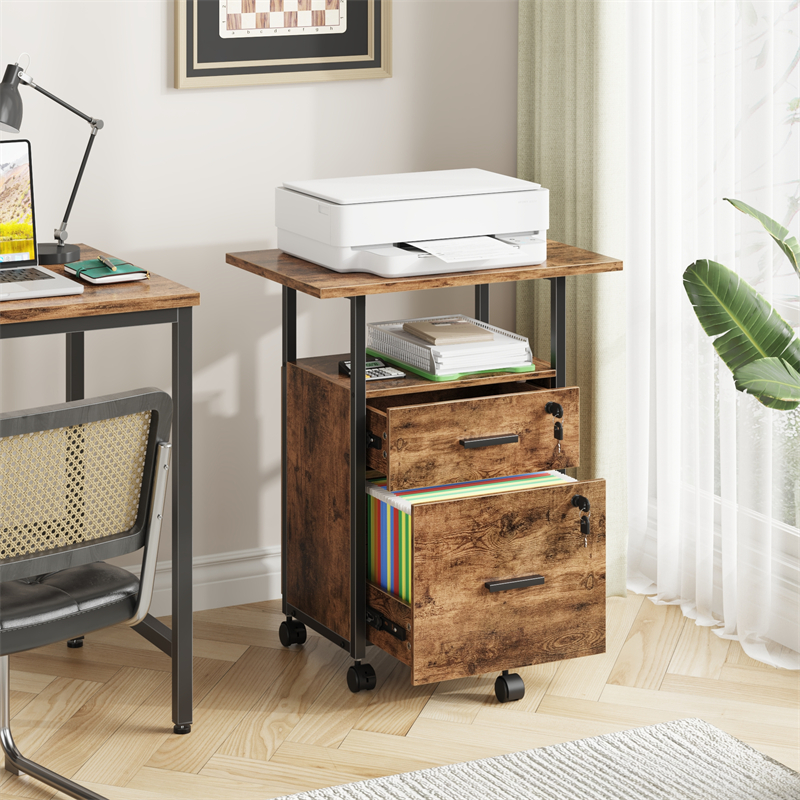
FC013 Locked Filing Cabinet - Tiger Wood
Who this helps
A home-office worker keeps paperwork split between a filing cabinet, a desk pile and a box, and keeps re-filing the same documents because nothing is ordered by how often it is actually needed. The cabinet in question is the FC013 Locked Filing Cabinet in Tiger Wood, whose drawer count, dimensions, rail support and lock coverage are not stated in the listing.
How to make the choice
Sort by retrieval frequency first and by subject second: give the most reachable drawer to documents you pull weekly or more, and place retained but unopened paperwork in the least reachable space. The trade-off is that a subject-based order explains itself to other people while a frequency-based order does not, so it needs a written index and a scheduled review to stay accurate.
Information behind this guide
Listing evidence for the FC013 consists of the model name, the Tiger Wood finish name and the word Locked; it states no dimensions, drawer count, rail compatibility, material or lock coverage, and a finish name does not establish construction. The frequency bands, drawer-reach logic, container checks and labelling routine here are general filing practice, not product specifications or performance claims.
Compare your options
| Option | Consider when | Limitation | What to verify |
|---|---|---|---|
| Weekly or more | Documents you reach for in an ordinary week: current accounts, active project files, correspondence that prompts an action. | This band grows quietly because anything added recently feels urgent, and the most reachable drawer is finite. | Count the folders you actually touched in the last month; if that number exceeds the drawer's usable depth, move the borderline ones down a band. |
| Occasional use | Statements, contracts and reference paperwork you look up a few times a year, where a short search is acceptable. | Slow retrieval is normal here, so a misfiled document can stay lost for months before anyone notices. | Confirm the drawer opens fully in its position, because a partly blocked drawer hides the folders at the back. |
| Retained but never opened | Records kept to meet a requirement or because disposal needs a decision, with no routine reading. | This band uses the most space while needing the least access, but it still has to stay dry, flat and identifiable. | Check the internal height of the lowest drawer against the boxes you plan to use, and ask whether any drawer load guidance exists. |
| Rare but time-critical | Papers you might need within minutes and under pressure: insurance, warranty, travel, medical and legal documents. | Frequency-based sorting pushes these to the back, and a lock can add a key search exactly when speed matters. | Decide which drawer the lock secures and keep a spare key where a second person can reach it; the listing does not state lock coverage. |
Your decision checklist
- Note every document you needed in the last month and the date you last used it; those dates, not the subject headings, set your first retrieval band.
- Measure the internal width, depth and clear height of each drawer you plan to use, and check its full travel, because drawer count and dimensions are not stated in the FC013 listing.
- Ask the seller whether the drawers accept hanging rails or a rail kit, and whether rail notches or a follower are fitted, before buying folders, rails or boxes.
- Ask what the lock secures, whether a key or code is supplied, and how a spare is obtained; the word Locked does not establish which drawers it covers or what it protects against.
- Write a one-page index of what sits in each band and keep it with the cabinet, so a document can still be found when its folder name is not the one you remember.
- Tie a review to a dated event such as a tax filing, a renewal or a warranty expiry, and move anything that has dropped a band down or out of the cabinet.
- If one band outgrows its drawer, move the borderline documents down a band before adding storage.
Related questions
Should I file by subject, by date or by sender?
Choose the order that matches how you will describe the document when you look for it. Subject order suits papers you recall by topic, chronological order suits statements, receipts and returns you recall by period, and sender or household-member order suits paperwork that should stay together. Most cabinets work best with one order per retrieval band rather than one rule for the whole cabinet; if your first guess changes from month to month, keep a one-page index instead of adding cross-references.
What should I do when the drawer I use most is already full?
Re-sort before you buy anything. A full high-frequency drawer usually means too many folders have been treated as urgent, so test each one against whether you would accept a short search for it and move the borderline folders to the next band down. An overstuffed single folder is a separate problem: split it into a current part and an archive part. Consider a larger cabinet or a second location only after that re-sort.
Does the FC013 listing tell you what the lock secures?
No. The listing carries the model name, the Tiger Wood finish name and the word Locked, and it does not state which drawers the lock covers, whether a key or code is supplied, or what it protects against. Ask the seller before planning the layout, because a lock on the drawer you open daily adds a routine step, while a lock on a rarely used drawer may not cover the records you wanted to secure.