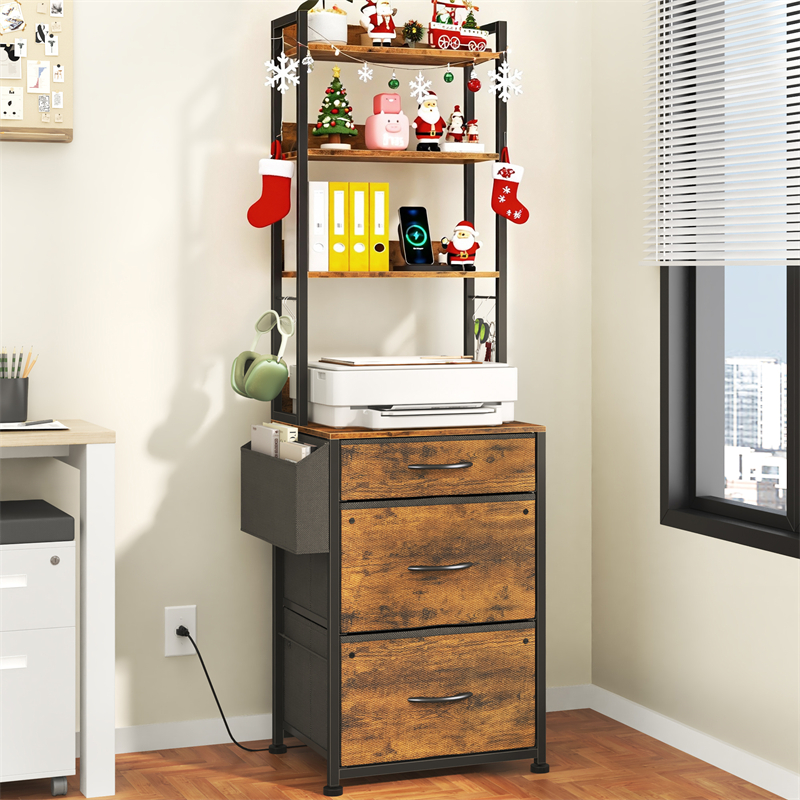
Place a three-drawer filing cabinet by workflow, then by wall space
The quickest way to choose a position for a three-drawer filing cabinet is to decide which drawer you will open most often, keep that drawer within reach of where you actually sit, and only then measure the wall. Wall-first planning tends to produce a cabinet that fits the room but not the way you work, because the drawer you need ten times a day ends up behind a door or out of the chair's reach. The FC004 Three-Draw high-end Filing cabinet is catalogued by GYIIYUO with three drawers; the catalogue entry supplied here lists no dimensions, drawer extension depth or weight limits, so the footprint and the space needed when a drawer is open have to be confirmed on the product page before you commit to a spot.
The most important limitation is that a filing cabinet does not only occupy its closed footprint. It also occupies the distance its drawers travel when open, plus the room a person needs to sit or stand in front of them. If those two zones are not planned together, a cabinet that looks correct on a floor plan becomes annoying in daily use, and the fix is usually a different position rather than a different cabinet.
Sort the paper before you measure anything
The useful first step is not a tape measure but a pile of paper. Divide what you keep into three rough groups: material you touch in a normal week, material you consult occasionally, and material you are retaining mainly for records. That sort tells you how the three drawers should be assigned and how close the cabinet needs to be to your desk. As a hypothetical example, a freelancer who invoices weekly and keeps signed contracts for years might use one drawer for current client paperwork, one for reference material, and one for closed projects, with the cabinet beside the desk because the first drawer is opened constantly. The same cabinet in a household whose only paper is bills and appliance manuals would be almost entirely archive, and it could sit further away without causing daily friction.
This sort also protects you from overbuying position. If only one drawer holds active material, that drawer earns the convenient location and the other two can sit lower or further back, which widens the number of places the cabinet can go.
Rank the three drawers by how often you open them
Frequency of use should decide which drawer tier matters most. The drawer you open several times a day belongs at the height you can reach while seated or standing at your working position, which is the quality worth protecting when you choose a location. Drawers you open monthly can sit lower or in a less convenient spot. There is a real trade-off: heavier archive material is generally easier to handle at a lower level than at shoulder height, but if you give the lowest drawer to active files you may find yourself bending all day for the paperwork you use most. Decide which routine dominates, then check the product specification for any weight guidance the manufacturer gives for drawers and follow that guidance rather than guessing.
Another trade-off is depth of storage against walking space. A position that pushes the cabinet further into the room may make the active drawer easier to reach, but it narrows the route behind your chair. In small rooms it is usually better to keep the active drawer close and accept a longer walk for archive than to keep every drawer equally reachable and lose the walking route.
Where the FC004 three-draw high-end filing cabinet can go, and when each position fails
Beside the desk, with the cabinet facing your seated position, is the natural home for active files. Check that the open drawer clears the desk return, the chair arms and any nearby door, and confirm the drawer extension depth from the product page before assuming a narrow gap will work. The catalogue entry supplied does not state that depth. Behind the desk chair or inside the chair's turning circle rarely works for active files, because you have to move the chair every time you open a drawer. It can suit a cabinet used mainly for archive, provided you can still stand in front of it comfortably.
Against a wall next to a door works only when the door opens fully with the drawer closed and the drawer opens fully with the door closed. Try both directions before deciding, and remember that a door stop or a thick skirting board can reduce usable wall length.
A closet, hallway or alcove can hold archive material, but check the closet door width, whether you can stand in front of the open drawer, and whether the hallway already carries traffic in that spot.
Under a window, account for radiators, curtain drops and cable runs, and keep the cabinet clear of heat sources as directed by the manufacturer. Any corner position deserves extra care because drawers opening diagonally into a walking route are easy to miss on a plan.
If the manufacturer supplies anti-tip or wall-fixing hardware, plan for it in the chosen position and follow the supplied instructions. If the specification does not mention it, ask before relying on the cabinet in a room used by children or on an uneven floor.
A measurement sequence you can finish in one sitting
Work through these steps in order so that no constraint is discovered after purchase. First, read the product page for the FC004 and note the stated width, depth and height, plus any drawer travel, assembly or fixing information. Second, note the full open-drawer projection if it is given, or plan a clear zone in front of the cabinet at least as deep as the drawer itself once you have that figure. Third, list every fixed element along the candidate wall: doors and their swing, radiators, outlets, switches, vents, skirting, curtain drops. Fourth, mark the cabinet footprint on the floor with masking tape and stand in the position you would use it from.
Fifth, tape the open-drawer zone as well and walk the route you take most often to confirm it still works. Sixth, check the path from your chair to the active drawer and count how many times you would have to stand up, lean over something or move furniture. Seventh, check the floor itself: level ground helps drawers run smoothly, and a rug edge under one corner is a common cause of a cabinet that rocks. Finally, check the delivery route, because a cabinet that cannot pass a stair turn or doorway cannot be used regardless of how good the room plan looks.
Common mistakes and what they cost you
Measuring only the closed footprint is the most common error, and the consequence is a drawer that strikes a desk leg, a chair or a wall on the first day. Choosing a position for appearance before testing the walking route leads to a cramped room and a cabinet that gets moved twice. Assigning drawers after the cabinet is full usually puts the heaviest, least-used archive in the easiest position and leaves active files where you must bend for them.
One more mistake is reading a product name as a material specification. The FC004 name describes the product and its drawer count; the catalogue entry supplied lists no material details, so confirm material, finish and care requirements on the product page before planning cleaning or placement near heat and moisture.
Before you order, confirm these details
Check the product page for overall dimensions, drawer extension or clearance guidance, assembly requirements, any included fixing hardware and the manufacturer's care instructions. If a figure is missing, ask for it rather than estimating, because the position you choose depends on the open-drawer zone more than the closed footprint.
Then make the decision in this order: assign each of the three drawers a purpose, decide which one must stay within comfortable reach, place the cabinet so that drawer is closest to your working position, and only accept the spot if the open drawer, the door swing and the walking route all clear at the same time. If one of those three fails, change the position or choose a different cabinet rather than living with the conflict.