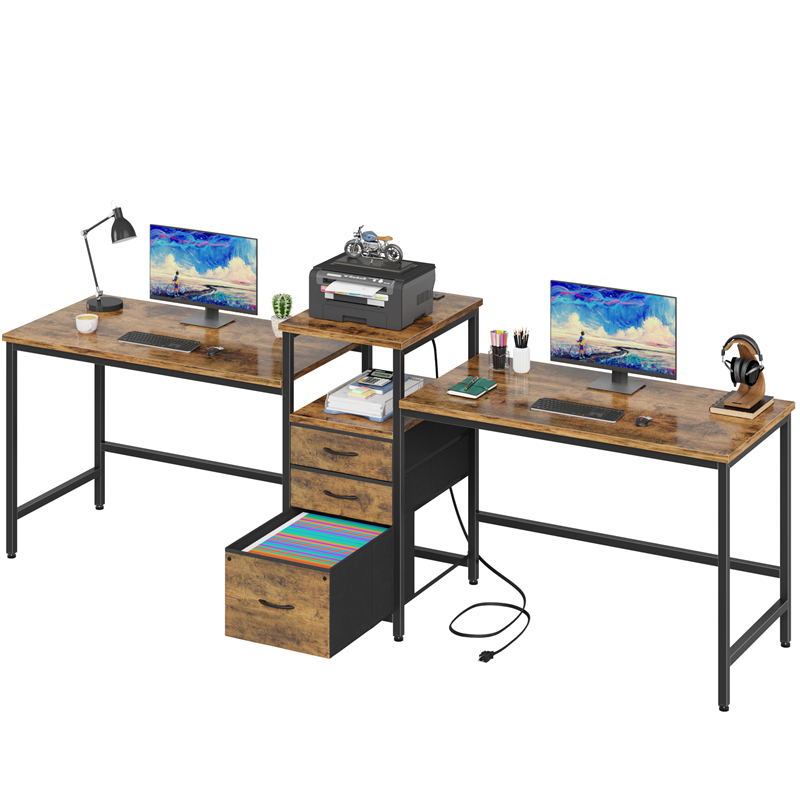
Overlapping Hours Decide This Before Dimensions Do
One shared desk suits two people whose sitting hours mostly do not overlap, or who can sit together without competing for the same working zone. It stops suiting them when both need the surface at the same time and one of them is on calls, using a second monitor, or spreading papers across the middle.
Start by writing down when each person actually sits down, not when they are nominally working. Two people can both work a full day and still share one desk comfortably if their desk time alternates, while two people who overlap for a few concentrated hours may still need separate surfaces because those hours are the ones that matter.
This is also the point where a shared desk stops being only a space question. If one person talks for much of the overlapping period, the other is sharing a room and a microphone, and no amount of extra width fixes that.
Measuring Two People on One Shared Surface
A shared surface works when each person's footprint fits beside the other's without either one giving up their own space. Measure each person's zone separately: the device and its base, the writing or notebook area they keep beside it, and the depth the chair travels when it is pulled out and occupied.
The contested part is normally the middle, not the ends. Two people each edge towards the centre as they spread out, so check what would sit between them: a shared lamp, a printer, a tray, or nothing at all. If the middle has to hold something both people need, the surface effectively loses that width for working.
Depth matters as much as length on a shared surface. A shallow top leaves the two users close together with little separation, while a deeper one may push the desk further into the room and reduce the floor left for the chair behind.
When Two Separate Workstations Suit Better
Two separate workstations suit overlapping hours, frequent calls, different monitor heights, or a routine where neither person wants to clear away at the end of a session. Each person gets their own reach, their own power and their own storage, and neither has to negotiate the middle of the desk.
The cost is duplication. Two desks mean two clear positions, two chairs, two sets of storage and twice the cable planning, and in a small room one of the two positions may be worse for daylight or door clearance. The room can also start to feel like an office rather than a shared living space.
Judge each position on its own terms. A desk tucked into a dark corner is not made acceptable by the fact that the other one is well placed, and a route that works when only one person is seated may fail when both chairs are pulled out at once.
The Middle Option: A Shared Desk Plus a Lighter Second Spot
A shared desk plus a lighter second spot suits a household where one person works mainly on a laptop and can move, or where one person works part time and does not need a permanent station. The main desk holds the fixed setup, and the second person uses a smaller surface, a folding table or the far end of another table when they need it.
This only works if the second spot genuinely exists in the room and has power within reach. If the second surface is also the dining table, the arrangement collapses at every mealtime, and the shared desk becomes the only real option regardless of how the hours overlap.
Treat the arrangement as a trial rather than a permanent plan. If the second person ends up at the main desk most of the time anyway, the household effectively has one workstation and should plan it as one.
What the D2007 Double Table Listing Does and Does Not Establish
The D2007 Double Table Tiger Wood listing gives a model name and a finish name, and nothing that can be used as a measurement or a capacity figure. The word Double in a product name does not establish that two people can work at it, and Tiger Wood describes a finish name rather than proving a solid-wood construction.
Before treating it as a shared desk, ask the seller for the exact width, depth and height with units, the position of the supports or legs, the clear span beneath the top, and any guidance the maker gives about use or load. The support positions matter especially on a shared surface, because they determine where each person can sit and whether a chair can pull in without hitting a leg.
If those figures are not available, plan the layout around a surface you can measure instead, or treat the desk as suitable for one person until the seller confirms otherwise. A photograph of two chairs at a desk is not a measurement either.
Power, Cables and Storage When Two People Share
Two users on one desk need enough outlets for both, positioned so neither person runs a cable across the other's working area. Work out in advance what stays plugged in: two chargers, a monitor, a lamp, a printer, and anything that is charged overnight rather than while working.
Decide which storage is shared and which is personal. A shared tray or shelf in the middle suits items both people use, while personal items work better in a container each person can lift away when their session ends, so the other person gets a clear surface rather than someone else's clutter.
Cable routes should avoid the chair zone. If both people sit at the desk, cables draped where feet and castors move will be caught repeatedly, and a route that each person can reach without leaning across the other is easier to maintain.
Test the Layout Before You Commit
Test the arrangement before buying anything. Tape the proposed desk outline on the floor, place two chairs at it and sit down at the same time, then check whether both chairs pull out, both people reach their own power, and the walking route past the desk stays open.
Run the test across a normal working week rather than a single quiet hour. Note the moments when the two routines collide, such as a call during a shared working period or both people needing the middle of the surface, because those collisions are the real signal about whether one desk can serve two people.
If collisions are frequent, the honest answer is two workstations or one fixed station plus a secondary spot, and the search should move to those options. If collisions are rare and both people fit at once, a single wider desk is the simpler buy, provided the seller confirms its dimensions and support layout.
Explore related furniture
D2007- Double Table Tiger Wood
Who this helps
Two people in one home need to work on the same days, with one wall or corner available for a desk. They are deciding between a single wider desk surface, such as the D2007 Double Table Tiger Wood, and two smaller desks placed separately.
How to make the choice
Choose a shared desk when the two users rarely sit at the same time, or when both can sit together with their chairs pulled out and their own power within reach. Choose separate workstations when hours overlap, when one person takes frequent calls, or when each needs a fixed setup. The trade-off is buying one surface against sharing clearance, power and storage.
Information behind this guide
The D2007 Double Table Tiger Wood listing supplies only a model name and a finish name, so its dimensions, material, support layout, load guidance and two-person capacity are unconfirmed and must come from the seller. The comparison points about overlapping hours, clearance, power and calls are general planning advice, not testing of this desk.
Compare your options
| Option | Consider when | Limitation | What to verify |
|---|---|---|---|
| One shared desk for two people | Two people whose desk hours rarely overlap, or who use the desk lightly enough that both can sit together and still pull out their chairs and reach their own power. | Both users compete for the same middle zone, the same outlets and the same storage. Simultaneous calls, two monitors or two people leaning into the shared area quickly become awkward. | Sit both people at the surface at the same time, with chairs pulled out, and count the outlets and cable routes each one needs before deciding. |
| Two separate workstations | Two people with overlapping working hours, frequent calls, different monitor or chair needs, or anyone who must leave a setup assembled between sessions. | Needs two clear positions, two sets of storage and twice the power planning, and in a small room one desk may end up in a poorer spot for light or door swing. | Assess each position separately for reach, light, power and door clearance rather than judging the two desks together as one footprint. |
| A shared desk plus a lighter second spot | One person working mainly on a laptop who can move, or one fixed setup combined with a part-time second workstation that only needs an occasional seat. | Only works if the second surface genuinely exists and is not the dining table needed at mealtimes, and it still requires power and a place to leave nothing behind. | Confirm the second spot has an outlet within reach and can be cleared completely at the end of a session. |
Your decision checklist
- List the days and hours each person actually sits at the desk, and mark where the two periods overlap.
- Measure each person's zone: device base, writing area beside it, and how far the chair travels when pulled out.
- Count the outlets each person needs and trace where the cables would run without crossing a walkway.
- Note whether either person takes frequent calls or needs screen privacy; that alone can rule out a shared surface.
- Ask the seller for the exact width, depth, height, support positions and any two-person or load guidance for the D2007 Double Table before treating it as a shared desk.
- Check the floor space left over after both configurations, not only the desk footprint itself.
- Tape the proposed outline on the floor and sit two chairs at it before buying anything.
Related questions
Can two people share the D2007 Double Table in Tiger Wood?
The listing does not establish that. It supplies a model name and a finish name, with no width, depth, clear span under the top or two-person capacity, so the word Double cannot be read as a specification. Ask the seller for exact dimensions, the position of the supports and any load or use guidance, then sit two chairs at the surface at once and check that both chairs pull out and both occupants reach their own power before treating it as a shared desk.
Is one long shared desk better than two smaller desks in a small room?
Not automatically. One wider desk needs a single position but both users pull their chairs from the same side, so the contested middle zone and the shared power route matter more. Two smaller desks each need their own clear floor for the chair and their own storage, yet they let two people work independently and can sit against different walls. Compare the clear floor left after each arrangement, not just the total desk length.
How should two people split storage on one shared desk?
Separate shared items from personal ones before assigning space. A printer, router or shared file tray belongs in the zone both people can reach without leaning across the other's work. Personal items such as headphones, notebooks or chargers work better in a tray or lidded box each person can lift away when the session ends, which keeps the shared surface usable for the other person instead of accumulating in the middle.