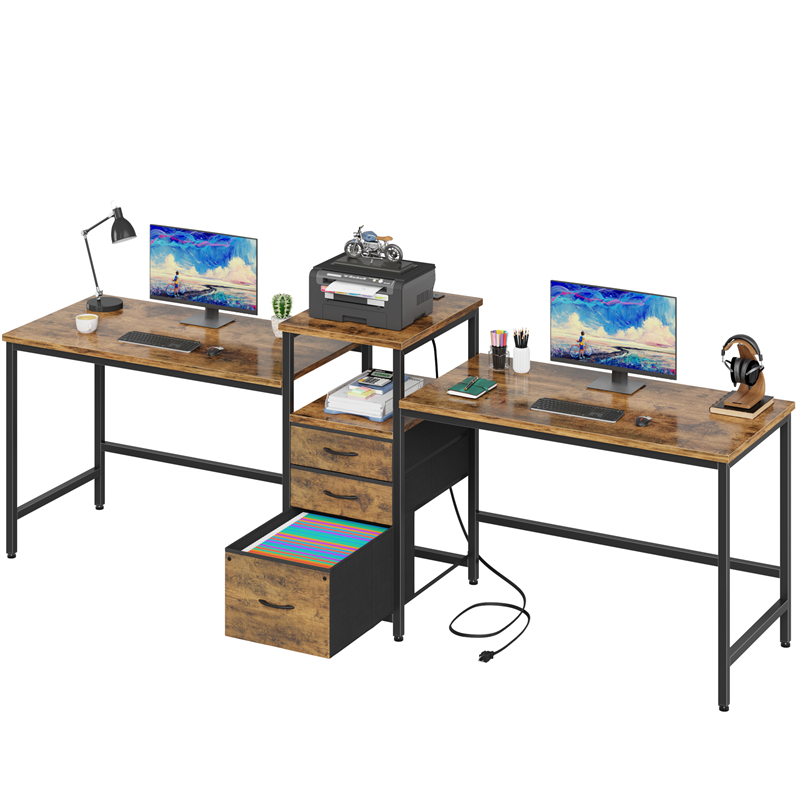
Which under-desk clearances decide whether storage fits
Under-desk storage fits only when three clearances survive: the height between the floor and the lowest point of the underside, the clear width between the desk's supports, and the usable depth from the front edge to whatever stops the unit at the back. Subtract the storage unit's own height, including castors or feet, from the first figure, then check width and depth the same way. A unit can clear the height and still be too wide to pass between supports, or too deep to sit under without meeting your shins.
Legroom is not a fixed empty box. It changes with how far you push the chair in, whether you cross your legs or use a footrest, and whether you wear shoes indoors. Measure with the chair in its working position and yourself seated, because a clearance that looks generous on an empty desk can disappear once someone is sitting there.
How to measure legroom using your own chair, not a general number
Measure legroom with your chair in the desk position and yourself sitting in it, because the useful clearance depends on seat height, arm height and how you sit. Slide the chair in as far as you normally would, then note where your knees, thighs and any footrest sit relative to the underside. Check whether you can move your feet back and stand up without hitting anything.
This records your situation rather than establishing a universal minimum. No figure in this article should be treated as a tested ergonomic threshold, and different people sharing the desk may need different clearances. If someone else uses the same desk, repeat the check with their chair and their habits, then plan for the tighter of the two.
Where under-desk storage sits, and what it blocks
Under-desk storage occupies part of the same volume your legs use, so its position matters as much as its size. A unit centred under the desk blocks the middle; one pushed toward a side support leaves a narrower but still usable knee space. Decide which part of the desk you actually sit at before deciding which part of the floor the storage can take.
Plan the movement as well as the parked position. Castors add height, a drawer or lid needs forward travel, and a box you lift needs a clear path in and out. Check that the unit can be opened and closed without you moving your chair, and that nothing blocks the desk's own structure. Testing the storage in use, not only in place, is what makes the decision reliable.
What the D2007 Double Table listing does and does not confirm
The D2007 Double Table in Tiger Wood listing on this site provides a model name and a finish name, and nothing that establishes under-desk clearance, the position of supports or any shelf structure. You therefore cannot decide from the listing alone whether a drawer unit, box or basket will fit beneath it.
Ask the seller for the underside height, the clear width between supports, the usable depth and whether any rail or shelf narrows that space. A finish called Tiger Wood does not indicate solid wood, board thickness or load behaviour, so treat those as unknown until the seller confirms them. If the answers overlap with your measurements, the arrangement is plausible rather than proven until the unit is physically in place.
Under-desk storage or storage elsewhere: the trade-off
Keeping storage under the desk shortens the distance between your chair and the items you use while working, which suits things you reach for repeatedly. Moving storage to a side cabinet, wall shelf or nearby filing cabinet keeps the legroom clear and costs you a turn, a step or an extra reach. The deciding condition is how often the stored items are used while seated; occasional items rarely justify taking floor-level space away from your legs.
If storage moves beside the desk, it needs its own clearance: a side cabinet's drawer or door still has to open, and a wall shelf has to sit where you can reach it without standing up and turning fully. Compare the inconvenience of the extra movement with the inconvenience of restricted legroom, and choose the one you would tolerate on an ordinary working day rather than on a tidy one.
A low-risk test before you buy or commit
Test the arrangement with a temporary box or a taped floor outline before buying anything, because an object can fit when parked and fail in use. Mark the footprint and height on the floor and against the desk, sit down, and run through a normal working session: push the chair in, shift your feet, get up and sit back down. If you keep moving your legs around the marker, the storage belongs somewhere else.
If you order a unit and it does not fit, the seller's return terms, packaging condition and collection arrangements decide how easily that can be undone, so read them before ordering rather than after. For the D2007, the useful next step is a written request to the seller for the underside and support measurements, because without them any under-desk storage plan remains unconfirmed.
Explore related furniture
D2007- Double Table Tiger Wood
Who this helps
You have a desk that already works for sitting and typing, and you want to slide a drawer unit, basket or box beneath it to clear the desktop, but you are not sure whether doing so will cost you the knee and foot room you use every day.
How to make the choice
Choose under-desk storage when the clear space still lets you sit, move your feet and push the chair in as usual; put the storage beside the desk or elsewhere when the unit, its castors or its pull-out travel intrudes on that space. The trade-off is a tidier desktop weighed against legroom you use every working session.
Information behind this guide
The D2007 Double Table in Tiger Wood listing on this site gives a model name and a finish name only, with no dimensions, clearances or construction details, so any under-desk fit must be confirmed with the seller for the exact unit. The measuring sequence here is general practice for matching storage to a desk, not an independently tested standard or an ergonomic threshold.
Your decision checklist
- Measure the height from the floor to the lowest point of the desk underside, including any frame, rail or crossbar, at the position where you actually sit.
- Measure the clear width between the desk supports at the point where the storage unit would pass, rather than the overall width of the desktop.
- Measure the storage unit with castors, handles and opened drawers or lids included, and note how far forward it travels when opened.
- Sit at the desk with the chair pushed in and check knee, thigh and foot movement before and after placing the storage, not only while standing.
- Ask the seller for the underside height, clear width, usable depth and any structure that narrows the space beneath the exact D2007 unit.
- Decide in advance where stored items will go if the space under the desk turns out to be unusable, so the desktop does not simply stay cluttered.
Related questions
Can I put a rolling drawer unit under any desk?
No. A rolling unit needs enough under-desk height for its body plus its castors, enough clear width to pass between the desk's supports, and enough forward travel to open without hitting your legs or the wall. Because castors raise the unit and drawers need pull-out space, a unit that fits when parked may not fit in use. Measure the desk and the unit, and confirm the exact clearance figures for your desk model.
Does the name Double Table tell me the clearance under the D2007?
No. A product name identifies the model or a design description; it does not establish underside height, the position of legs or supports, or whether any shelf or crossbar narrows the space. The D2007 Double Table in Tiger Wood listing on this site shows only a model and finish name, so ask the seller for the underside height, clear width and usable depth before assuming a storage unit will fit beneath it.
Is there a standard legroom figure I should aim for under a desk?
There is no single figure that suits every person, chair, footwear and working routine, and a general layout suggestion is not an ergonomic or accessibility standard. Measure the space under your own desk with your own chair in the position you use it, and account for anyone else who sits there, including people who use a mobility aid. Local requirements may apply separately; check the actual clearance rather than assuming one number fits all.