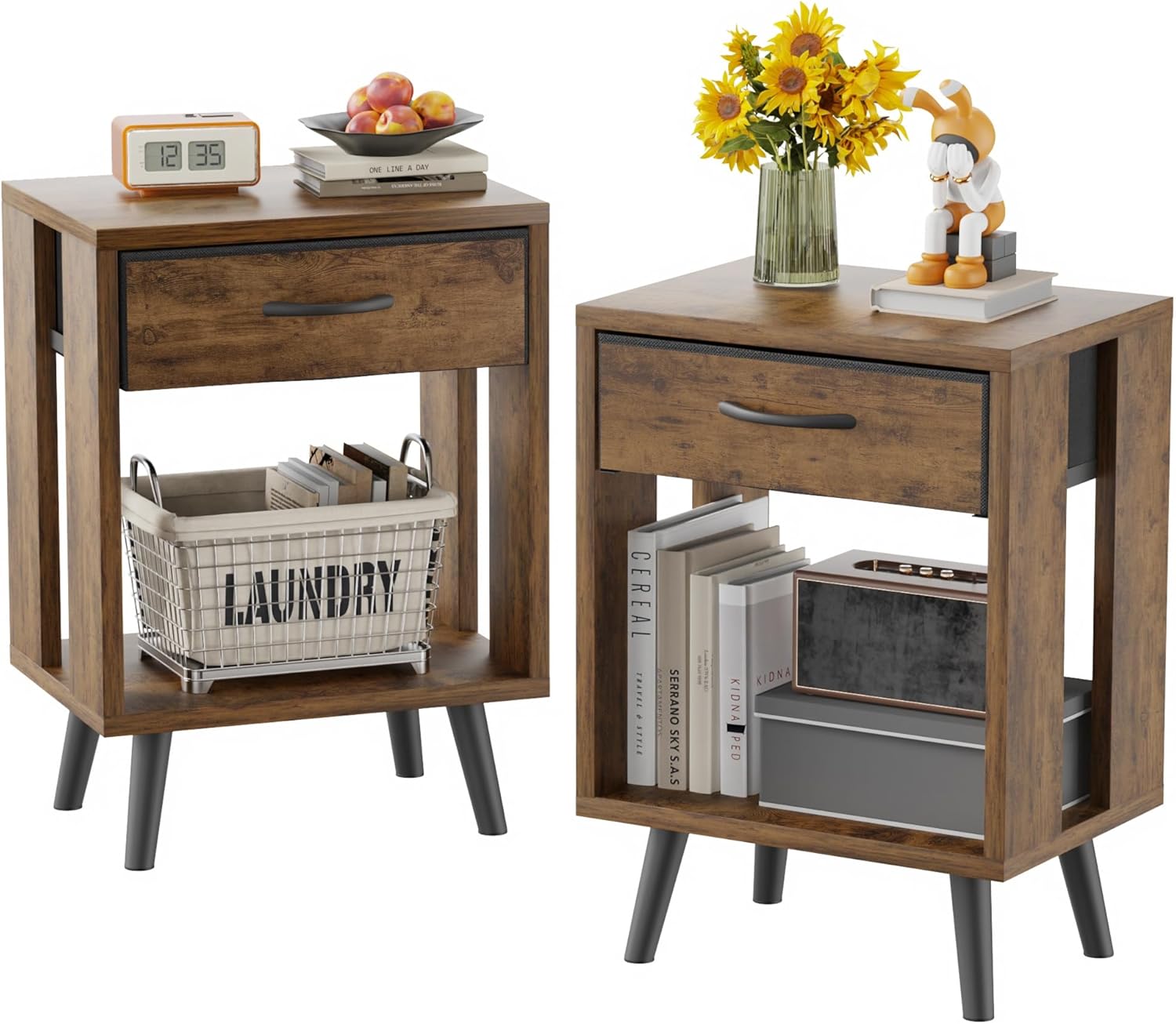
Map every moving edge around the bedside position
A nightstand position is workable only when four moving paths can share the floor zone without forcing a collision: the room door, the wardrobe door, the drawer pull and your bedside approach. Trace each path separately rather than checking whether the nightstand body fits. Use the listed 15.7 in L by 11.8 in W footprint as the fixed starting point; the 23.6 in H figure describes overall height, not where each drawer front sits or how far it travels.
A footprint template helps because the listed length and width describe the nightstand, not the room needed to use it. Cut a paper or cardboard rectangle to the listed size, place it at the intended position and mark the door and wardrobe arcs around it. Do not substitute the nightstand width for the door's swing: a door pivots from its hinge, so the deepest intrusion may be at the free edge or the handle.
Trace a room door from its hinge, not its opening width
Trace a room door from its hinge because the leaf and its handle sweep through an arc that the opening width alone does not describe. Note the hinge position, leaf thickness and handle projection, then move the door slowly through the full angle you normally use with the nightstand template in place. Mark the leaf edge at floor level and the handle path at the height of the nightstand top and drawer pulls.
Run the check with the door at its normal stop and again at the angle you use when entering with your hands full. If the nightstand prevents the door from reaching its stop, or if opening the door pushes you into the bedside approach, the position fails even when the table itself fits. The listing gives no drawer travel, so do not assume a closed door and an open drawer occupy separate zones until the pull-out distance is confirmed.
Test the wardrobe leaf you actually open
Test the wardrobe leaf you open daily, because a second leaf that stays closed does not create the same conflict and can make the layout look more generous than it is. Open the chosen leaf to the angle you need to remove clothes or reach the rail, then note both the leaf's swept area and the standing space you occupy.
A wardrobe door that opens only partly may still be workable if you can reach the contents and do not need the leaf flat against a wall. The test is practical: with the nightstand template in place, open the wardrobe through the usable angle, stand where you would stand, and see whether the leaf, your body and the bedside approach compete. If everyday access needs a wider opening than the nightstand allows, do not treat a partly open leaf as a resolved conflict.
Match the drawer pull to the drawer front, not the nightstand width
Match the drawer pull to the drawer front itself, because the listed 15.7 in length describes the whole nightstand and the listing gives no drawer-front width or pull-out distance. Ask the seller for the drawer front width, height, internal depth and travel, then make a template of the front and pull it straight out from the closed face.
Check both drawers at the height where your hand grips the pull. An open drawer needs room for the front, your fingers and whatever you lift out; a partial opening may be adequate for small items but awkward for a book or bedding. Also test the sequence with the room and wardrobe doors in the positions you normally leave them, because a path that works only when everything else is closed is a routine constraint rather than a one-off measurement.
Leave a real standing place for the bedside approach
Leave a standing place for the bedside approach, because a nightstand can clear both doors and still be unusable if you must stand in a door's swing arc to open a drawer. Test the approach with the nightstand template in place and the doors where you normally leave them. If you must stand in the swing path to reach the lamp, open shelf or drawer, the conflict is with your body, not just the furniture.
Judge reach from the position you actually use. The listed 23.6 in H gives overall height, not the height of a pull or the internal drawer, so do not choose the position by that figure alone. The useful question is whether you can reach the top, the open shelves and the drawer pull without moving the unit or stepping into a door path.
Check each side of the bed independently
Check each side of the bed independently, because a matching set of two does not make the room door, wardrobe or bedside approach identical on both sides. The room door may sit on one side, the wardrobe on the other, or one approach from the mattress may be shorter. Test the left and right positions separately with the same four paths, and record which side borrows space from a door or wardrobe.
If one side fails, the pair is useful only if you have another workable position for the second unit; otherwise the set creates an unused piece. Do not assume the two units must sit symmetrically. A position that works on one side may be a false guide for the other because the hinge side, handle projection and standing room differ.
Decide the sequence before you buy the set
A fixed sequence can make overlapping paths workable only if every user can follow it and the item that must move is easy to operate. Closing the wardrobe before opening a drawer, or opening the room door only when the bedside drawer is shut, is acceptable only when that order survives a tired evening and both sides of the bed follow the same routine.
Before ordering, confirm the drawer pull-out distance, internal drawer dimensions, assembly requirements and the space the pulls need; the listing does not provide those details. If the seller cannot confirm drawer travel, leave a test gap in the layout rather than assuming the door and drawer will coexist. Then mark both bedside positions with the listed footprint templates and run each door and drawer path once with the actual items you keep beside the bed.
Explore related furniture
Fabric-Drawer Nightstand Set of 2 — Dark Rustic Brown
Who this helps
A reader has two bedside positions with a hinged room door on one side and a wardrobe on the other, is considering the matching fabric-drawer set, and wants to know which door, drawer and bedside paths can share the floor without a daily collision.
How to make the choice
Choose the bedside position only when the room door, the wardrobe leaf you use, the drawer pull and your standing approach can each complete without crossing an active path, or when you can sequence those movements reliably. If two paths overlap and closing one item every time is unacceptable, move the nightstand or choose a different storage arrangement; a matching pair does not override the conflict.
Information behind this guide
The listing confirms a set of two nightstands with fabric drawers and open shelves in dark rustic brown, with listed dimensions per nightstand of 15.7 in L by 11.8 in W by 23.6 in H. It gives no drawer pull-out distance, internal drawer dimensions, load limits or assembly details, so those remain unknown. Door-swing and approach checks here are space-planning advice, not tested clearances; confirm the missing figures with the seller before ordering.
Your decision checklist
- Tape the room door's full everyday swing on the floor, then mark the handle's path at the heights of the nightstand top and drawer pulls.
- Open the wardrobe leaf you use most and mark its actual swept area and the standing space you need to reach the contents.
- Cut a 15.7 in by 11.8 in footprint template for one nightstand and place it at each bedside position before comparing paths.
- Make a separate template for each drawer front and pull it out from the closed nightstand face to the distance your hand and contents need.
- Test the bedside approach with the room and wardrobe doors where you normally leave them, not only when everything is closed.
- Run the check on both sides of the bed; do not assume a matching pair faces the same door, hinge or wardrobe layout.
- Write down which item must close before another can open, and reject the position if that sequence fails in daily use.
Related questions
How do I test a wardrobe door that opens only part way?
Open the leaf to the widest angle the room allows with the nightstand template in place, then stand where you would stand to reach clothes. A partial opening can be acceptable if you can see and reach the section you use and the leaf does not push you into the bedside approach. If you need the leaf flat against the wall to reach everyday items, treat the position as a conflict rather than forcing the door.
What should I do if the nightstand fits but a drawer cannot open fully?
Ask the seller for the drawer pull-out distance and internal dimensions before deciding, because the listing does not give them. Pull a cardboard template of the drawer front out to the distance you need, then check your hand and body space. A partial opening may be enough for shallow contents you can reach, but not for items you must lift clear; if the drawer cannot serve its intended contents, change the position.
What should I check after the nightstand set arrives?
Place each nightstand empty in its planned position and operate the room door, wardrobe leaf and both drawers through their full everyday paths before loading anything. Check that the unit sits stable and that any assembly or restraint instructions are followed. If a path fails, reposition the empty unit while it is still easy to move; do not wait until the drawers and top are full.