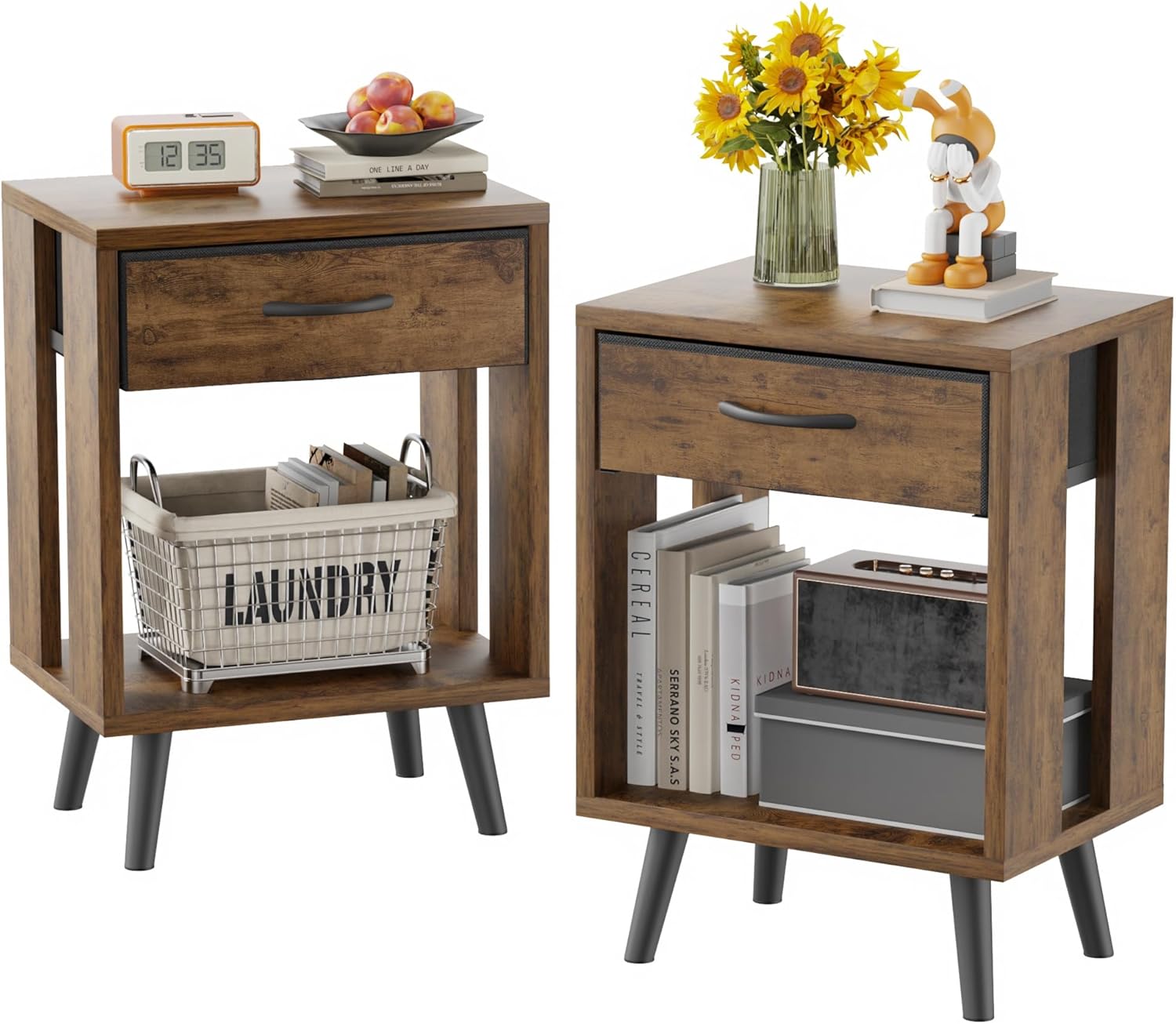
Begin With the Items You Handle From Bed
The clear utility area on each nightstand top should be sized around the items you handle from bed, because those items set the minimum usable surface. Include the lamp base and switch, a phone, the charger or cable, glasses, a book and a drink; group them as they would sit together rather than measuring each in isolation. The listed overall dimensions are a starting point, not proof that the whole top is flat or usable.
A common mistake is to style the top first and then squeeze the nightly items around the display. Reverse that order: draw a utility rectangle on paper or mark it with removable tape, then test whether the lamp, charger and a glass can sit inside it without overhanging the edge. If the display only fits by covering that rectangle, it is not a workable bedside arrangement.
Check the switch and drawer pull, not just the object footprints. A lamp can fit on the top and still be awkward to switch from the mattress; a drawer pull can be reachable while the open shelf below is blocked by a basket or trailing cable. Walk through the actual sequence: lie down, reach for the phone, switch the lamp, open the drawer. That sequence reveals whether the display is in the way.
Use the Pair Asymmetrically When the Two Sides Differ
The two nightstands in this pair do not need identical top layouts, because each user may have a different reach, outlet position and bedtime routine. Use more display on the side that needs less nightly clear space, and keep the other top more available for a lamp, charger or drink. The deciding condition is each person's access, not the symmetry seen from the doorway.
Test each side independently. On one side, the outlet may sit behind the table; on the other, a door or bed frame may limit how far you can stand while plugging in a charger. Those differences change where a decorative object can sit without being moved every night. A display that works on one side may become the first thing that has to be lifted on the other.
If both sides must look coordinated, coordinate through a repeated shape or a shared tray rather than forcing identical object placement. The visual link can come from one repeated bowl, clock or small frame, while the clear space stays tailored to each user. That preserves the pair's coordinated look without pretending the two bedtime routines are identical.
Make the Display Lift Off in One Move
A zoned display works on a bedside top only when it can be lifted clear in one move. Use one tray, one lidded box or one self-contained object rather than a scatter of small items, because the point of the zone is that it can leave the utility area free when needed. Check that the tray or group fits within the top area you have marked and does not hang over the edge.
The condition is clearance, not decoration. A tray that catches a charger cable as it is lifted, or a tall object that must be moved before the lamp switch can be reached, defeats the purpose. Test the lift with the cable in place and with the drawer open; the display should not force you to set it on the floor or balance it on the bed.
Do not assume the open shelf below is a reserve display location simply because the listing confirms open shelves. Its internal width, depth and height are not given, so measure any object you intend to move there and ask the seller for the shelf figures. If the object only fits with a tilt or an overhang, keep it off the shelf and move it to a separate wall surface instead.
Choose Display Objects That Tolerate Bedside Handling
Decorative objects on a bedside top should tolerate being reached past, dusted and occasionally shifted; that is a more useful criterion than whether they match the room's colour scheme. Favour a stable base, a size that leaves the utility rectangle clear, and no loose cord that can tangle with a charger. The listing's dark rustic brown is a colour designation, not a confirmed finish or care specification, so do not choose a cleaner or a heavy object on the assumption that the surface is sealed or load-rated.
Keep decorative objects clear of the lamp and charger, following their own instructions for clearance. These are placement checks you can make in the room, not product claims; the seller should confirm any care or load limits for the nightstand. If an object needs to be moved before the lamp can be switched or the drawer opened, it belongs on a wall shelf or another surface, not on the top.
For a low-effort routine, limit the display to one or two pieces that can be dusted without lifting the lamp. Rotate seasonal items only if you have somewhere else to store them, because the fabric drawers and open shelves are already part of the bedside storage plan. The aim is a top that still reads as styled from the doorway but remains usable from the mattress.
Decide What the Listing Leaves Open Before You Commit
The listing settles the pair's broad format: two nightstands, fabric drawers, open shelves, a dark rustic brown colour and overall dimensions per nightstand. It does not give the usable top dimensions, internal drawer or shelf measurements, load limits, surface material or care instructions. Those gaps matter because a decorative tray, lamp or stack of books can only be allocated after the real clear area is known.
Ask the seller for the top's usable width and depth, the internal drawer and shelf dimensions, and any load guidance before you plan a heavy display. If the answer is incomplete, keep the decorative group light and movable, and avoid placing anything on the open shelf until its clearance is confirmed. This is not a reason to reject the pair; it is a reason to keep the first arrangement provisional.
The final decision rule is simple: a decor-led top is acceptable only when the nightly utility items still work without moving the display. If they do not, choose a clear utility top or a one-move display zone instead. The trade-off is visual warmth against nightly ease, and it can be decided differently on each side of the bed.
Explore related furniture
Fabric-Drawer Nightstand Set of 2 — Dark Rustic Brown
Who this helps
You are setting up a matching pair of bedside tables in a dark rustic brown bedroom and want the tops to look intentional without losing the clear space needed for a lamp, phone, charger, glasses or a glass of water at night.
How to make the choice
Choose a decor-led top only when every nightly item still has an unobstructed place and the display can be lifted clear in one action; otherwise choose a clear utility top or a zoned hybrid. The trade-off is visual warmth against nightly convenience, and the two sides can follow different rules if their reach and outlets differ.
Information behind this guide
The listing confirms a set of two nightstands with fabric drawers and open shelves in dark rustic brown, plus overall dimensions per nightstand of 15.7 in long, 11.8 in wide and 23.6 in high. It does not give usable top, drawer or shelf dimensions, load limits or care instructions; those remain checks with the seller, not assumptions.
Compare your options
| Option | Consider when | Limitation | What to verify |
|---|---|---|---|
| Decor-led top | A bedside where the top is mainly seen from the doorway and decorative objects can sit outside the lamp, charger and drink reach path. | Leaves less clear space for nightly items; every object must be lifted or shifted when the routine changes. | Fix the lamp, charger and drink positions first, then confirm each decorative object clears them and does not overhang. |
| Clear utility top | A bedside used every night for a lamp, phone, charger, glasses, book or drink, where the top must stay easy to use without rearranging. | Looks sparse and may push decorative objects onto walls or other furniture; without a tray or drawer routine, small items can still collect. | List the nightly items, measure their combined footprint and test cable route and switch access from the mattress. |
| Zoned hybrid | A bedside that needs some visible decoration but still has to switch between display and nightly use quickly. | A small top can make the zones compete; a multi-piece display is harder to lift clear than one tray or object. | Lift the display group with the charger cable connected; it should clear the lamp switch, drawer pull and any drink without being unloaded. |
Your decision checklist
- List every item that must stay on the top overnight, including the lamp, phone, charger, glasses, book and drink, and measure their footprints with the plug and cable in place.
- Mark a utility rectangle on each top with removable tape, then place decorative objects only outside it and check that nothing overhangs the edge.
- Test the lamp switch, charger port and drawer pull from the usual sleeping position without moving a display item first.
- Check each side separately for outlet position and cable route so charging cables do not cross the top or hang where they can be caught.
- Move decorative objects to a wall shelf or another surface if they block nightly access, and confirm open shelf dimensions before using that shelf for display storage.
- Ask the seller for usable top dimensions, internal drawer and shelf measurements and any load limits before adding heavy decorative pieces.
Related questions
Can the two nightstands use different top layouts?
Yes, if each user's reach, outlet and storage routine differ. A matching pair is visually coordinated, but the set listing does not require identical top styling or prove that both sides are used the same way. Keep a clear utility zone on each side, then give the remaining top to display. Coordinate with one repeated object or tray rather than forcing identical placement.
How much top space does the pair actually provide?
The listing gives overall dimensions per nightstand of 15.7 in long, 11.8 in wide and 23.6 in high, but not a separate usable top measurement. Do not treat the full overall rectangle as clear, flat surface. Ask the seller for the top's usable width and depth, any edge profile and the internal drawer and shelf dimensions before planning a fixed display.
Where should decorative items go if the top must stay clear?
Move purely decorative objects to a wall shelf, a separate surface or a storage box, not to the open shelf until its internal dimensions are confirmed. Keep the bedside top for what you handle from the mattress. If you want some display, reduce it to one liftable group that clears the lamp, charger and drawer pull without being moved item by item.